
The ULTIMATE Guide to Plasticity BASIC by Blender Bros – Immediately Download
If you have ever felt that Blender hard-surface modeling is more “problem-solving” than “creating,” you are not alone. Many artists hit the same wall: topology cleanup, shading artifacts, modifier stacks that break at the worst moment, and workflows that feel heavier than the design itself.
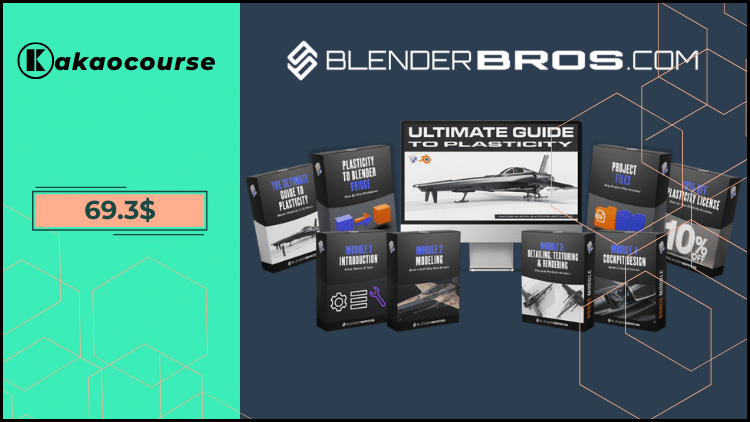
The ULTIMATE Guide to Plasticity BASIC by Blender Bros offers a more direct route—built around NURBS-based CAD-style modeling that prioritizes smooth surfaces and predictable edits. The full course package is 7.60 GB and costs $69.3, making it an accessible, international-friendly training option for artists who want results without spending months untangling technical friction.
This course is designed to be completed in under 12 hours, taking you from installation and interface familiarity to practical modeling and a polished rendering pipeline—without requiring you to become a “technical Blender wizard” first.
Free Download The ULTIMATE Guide to Plasticity BASIC by Blender Bros – Here’s What You’ll Get Inside:
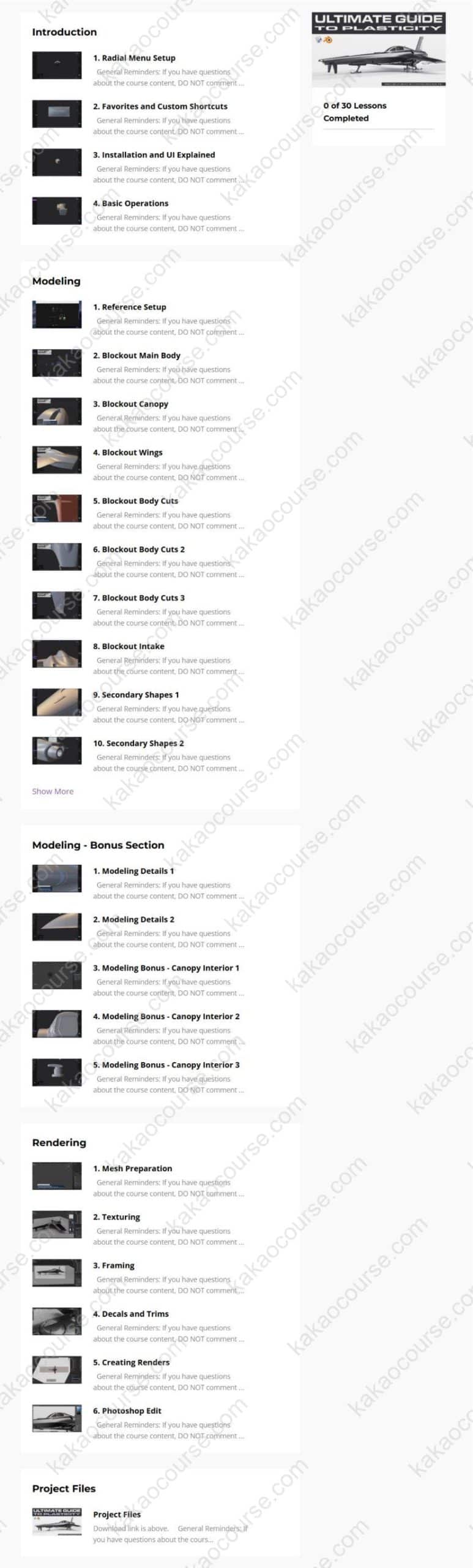
The ULTIMATE Guide to Plasticity BASIC by Blender Bros, Check Out the Full Course Contents:
The ULTIMATE Guide to Plasticity BASIC by Blender Bros, Watch Our Free Video Sample to Find Out More:
The ULTIMATE Guide to Plasticity BASIC by Blender Bros, Check Your Free PDF Sample Here:
🧩 Overview This Course
The ULTIMATE Guide to Plasticity BASIC is a structured training program that teaches you how to model hard-surface designs in Plasticity efficiently, then bring those models into Blender for high-quality portfolio rendering.
Plasticity is a newer 3D modeling application built on NURBS geometry. In practice, that means your forms are driven by curves and surfaces rather than dense polygon meshes. For many hard-surface tasks, this translates into a workflow that can feel more like designing and less like repairing.
The course moves through three main stages:
-
Stage 1: Setup and orientation (approximately 47 minutes)
Learn installation, interface configuration, menu setup, and shortcuts so the software fits your working style. -
Stage 2: Practical modeling through a guided project (approximately 5 hours)
Build a sci-fi ship from the ground up while learning tools in context—so you internalize workflows, not just buttons. -
Bonus modeling: detailing and concept-thinking (approximately 3 hours)
Push beyond basic forms into purposeful detail design, including a cockpit interior—training both technique and design logic. -
Stage 3: Rendering pipeline in Blender (approximately 2 hours 40 minutes)
Prepare geometry, import through a bridging workflow, texture, compose, light, render, and refine. A dedicated post-production segment in Photoshop is included as a bonus.
Overall, this is not a random collection of tips. It is a deliberately sequenced path from “I’m new to Plasticity” to “I can model clean hard-surface assets and present them professionally.”
✅ Why Should You Choose This Course?
Choosing a 3D course is rarely about the software alone—it is about reducing the time between learning and producing portfolio-ready work. This course is compelling for three reasons: speed to competency, clarity of workflow, and an end-to-end pipeline that reflects real production expectations.
1) It reduces common hard-surface bottlenecks
If your current workflow is slowed by mesh-related problems—unwanted overlaps, shading glitches, or repeated cleanup cycles—Plasticity’s NURBS approach can feel refreshingly direct. You spend more time shaping and refining forms, and less time troubleshooting geometry behavior.
2) It is built for fast onboarding
Plasticity is generally simpler to navigate than full-scale DCC suites. This course takes advantage of that by focusing early on the interface and essential operations, so you can begin modeling quickly—often the missing piece in beginner learning.
3) You do not stop at “modeling”
A model that looks great in viewport is not the same as a model that looks hireable in a portfolio. This course devotes meaningful time to rendering and presentation: framing, material workflow, lighting, and post-processing—skills that convert solid assets into professional visuals. 📌
4) It is taught by specialized hard-surface educators
Blender Bros are known for hard-surface education and production-oriented workflows. The instructor team includes:
-
Ryuu, a Tokyo-based multi-genre artist and educator focused on hard-surface concept work.
-
Josh Gambrell, a hard-surface artist and long-time Blender educator with extensive tutorial experience.
Their combined teaching approach tends to emphasize repeatable processes and practical outcomes—useful for learners who want predictable improvement.
🧠 What You’ll Learn
By the end of this course, you should be able to model hard-surface forms in Plasticity with confidence, then move those assets into Blender for high-end rendering and portfolio presentation.
Key learning outcomes include:
Plasticity foundations (setup + usability)
-
Install and configure Plasticity for an efficient workspace
-
Build menus and layouts that support speed and clarity
-
Use customized shortcuts to reduce repetitive actions
-
Perform core operations without feeling “lost in the UI”
NURBS-based hard-surface modeling (the practical core)
-
Create clean surface forms using curve- and surface-driven tools
-
Build complex shapes without the usual mesh-topology maintenance
-
Edit forms non-destructively and iterate rapidly
-
Approach modeling as “design refinement,” not “polygon management”
Project-based execution (a guided sci-fi ship build)
-
Translate reference ideas into structured forms
-
Block out primary shapes, then progressively refine
-
Learn tool usage in context so you retain it longer
-
Develop the confidence to start original models independently
Detailing and concept thinking (bonus modeling)
-
Add purposeful detail without cluttering the design
-
Improve visual storytelling through surface and interior decisions
-
Build a functional cockpit interior as an advanced exercise
-
Train your “concept artist mindset” alongside technique
Rendering mastery in Blender (portfolio output)
-
Prepare meshes for rendering and handle import workflows
-
Use a bridge workflow to transfer models efficiently
-
Texture using production-style material tools (where available)
-
Build strong render compositions (camera and framing)
-
Enhance realism via decals and trim sheet detailing
-
Create compelling lighting setups and render outputs
-
Refine final images in Photoshop for a polished presentation
If your goal is “model → render → portfolio,” this learning path is aligned with that outcome.
✨ Core Benefits
This course is particularly effective when evaluated through real-world benefits: time saved, fewer technical blockers, and higher-quality deliverables.
Benefit 1: Faster iteration with fewer modeling headaches
NURBS-based workflows often allow smoother editing and cleaner surfaces during the design stage. That makes it easier to test shape variations quickly—an advantage for concept-driven hard-surface work.
Benefit 2: A structured learning arc under 12 hours
Rather than an open-ended curriculum that drifts into complexity, the program is compact and sequential:
-
Setup fundamentals
-
Practical modeling through a complete project
-
Advanced detailing mindset
-
Rendering and presentation
This structure helps learners finish the course—and finishing matters more than starting.
Benefit 3: Portfolio-oriented rendering emphasis
Many beginner CAD-style courses stop at modeling. This one invests in the final mile:
-
composition
-
lighting
-
material workflow
-
post-processing
That focus supports a clear professional goal: visuals that communicate skill.
Benefit 4: Less dependence on topology troubleshooting
For artists coming from polygon workflows, a large portion of time can go into cleanup and error correction. Plasticity’s modeling paradigm can reduce those pain points for many hard-surface scenarios—helping you stay creative and consistent.
Benefit 5: Transferable skills across workflows
Even if you later return to Blender modeling, the design habits you build here—clean form thinking, surface awareness, controlled detailing—can improve your results across tools.
👥 Who Should Take This Course?
This course is designed for international learners who want a simpler modeling workflow, stronger hard-surface results, and a clear rendering pipeline. It is especially suitable for:
-
Blender users who are frustrated by hard-surface mesh complexity and want an alternative modeling approach
-
Beginners in 3D who want a fast, guided entry into CAD-style modeling
-
Concept artists and hard-surface designers seeking rapid iteration and clean surface control
-
Game/film/visualization learners who want portfolio-ready renders, not only technical exercises
-
Freelancers and job-seekers building a professional body of work where presentation quality matters
-
Busy learners who prefer a course designed to complete in under 12 hours, rather than a long, open-ended program
This course may be less ideal if you are looking exclusively for advanced polygon topology techniques or deep procedural shading theory. Its strength is efficient modeling in Plasticity plus high-quality rendering in Blender.
🏁 Conclusion
The ULTIMATE Guide to Plasticity BASIC by Blender Bros is a focused, project-driven program that teaches you how to model hard-surface assets in Plasticity using a NURBS-first workflow—then present those assets at a professional level through Blender rendering and post-processing.
If your priority is reducing technical friction (topology issues, shading artifacts, and overly complex mesh workflows) while still producing sophisticated designs, this course offers a pragmatic path: learn the tool quickly, apply it in a full build, refine detail with intention, and render with portfolio standards.
The course package is 7.60 GB and costs $69.3, making it a cost-effective option for learners who want a complete modeling-to-render pipeline without committing to an extended multi-month curriculum.
Enroll now and start building clean, high-impact hard-surface models you can confidently showcase in your portfolio.



Reviews
There are no reviews yet.