
How to Use Copyediting for Career Advancement and Side Profit By Mindy McHorse – Immediately Download
In a world flooded with online content—sales pages, emails, blog posts, landing pages, product descriptions—the difference between “publishable” and “high-performing” often comes down to one discipline: copyediting. It’s the craft of making writing clearer, more consistent, more persuasive, and easier to trust—without changing the author’s intent or voice.
How to Use Copyediting for Career Advancement and Side Profit by Mindy McHorse is a structured, self-paced program designed to teach copyediting as both a professional skill set and a practical service you can apply across industries. The course is delivered as a 1.20 GB digital package and is priced at $93.1.
If you want a skill that translates across niches—marketing, publishing, e-commerce, education, SaaS, and beyond—copyediting is one of the most portable options available. This course focuses on turning that option into a clear, repeatable workflow you can actually use.
Free Download How to Use Copyediting for Career Advancement and Side Profit By Mindy McHorse – Here’s What You’ll Get Inside:
How to Use Copyediting for Career Advancement and Side Profit By Mindy McHorse, Sneak Peek Inside The Course:
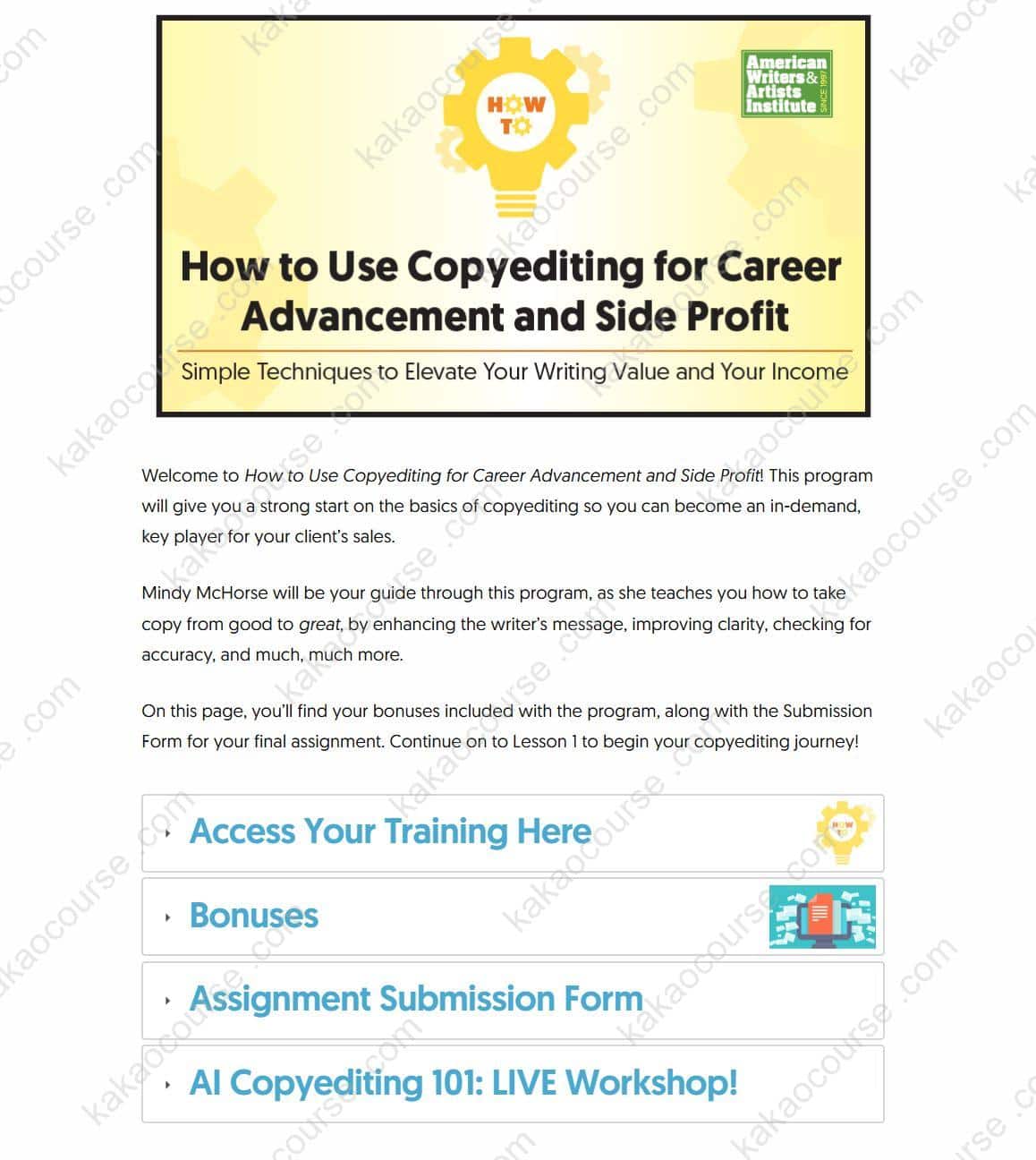
How to Use Copyediting for Career Advancement and Side Profit By Mindy McHorse, Check Out Content of part “Access Your Training Here”:
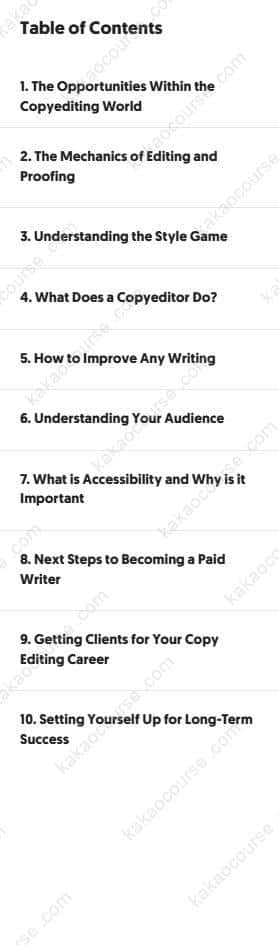
How to Use Copyediting for Career Advancement and Side Profit By Mindy McHorse, Quick Free Video for More Information:
Overview This Course
This course is built around a simple idea: copyeditors aren’t just “grammar checkers.” A high-quality copyeditor improves readability, consistency, and audience fit—while protecting the writer’s voice and the brand’s standards.
The program is organized as a 10-lesson core curriculum supported by bonus resources. It moves from foundational concepts (what copyediting is and where it fits) to hands-on mechanics (how to mark edits efficiently), to style systems (guides and style sheets), to real-world service delivery (types of edits), and finally to professional positioning (freelance setup and client acquisition).
What makes it especially relevant for international learners is that it treats copyediting as a process—not a personality-driven talent. You learn:
-
What to look for
-
How to decide what to change (and what not to change)
-
How to document standards so work stays consistent
-
How to deliver edits professionally in typical client workflows
In other words, it teaches copyediting as a skill you can build, measure, and refine.
Why Should You Choose This Course?
Many people try to “learn copyediting” by collecting rules. That approach fails because professional copyediting isn’t rule memorization—it’s decision-making under constraints: audience expectations, brand voice, style preferences, deadlines, and document complexity.
This course stands out because it treats copyediting as a career-grade capability, combining craft and professional practice.
Reasons to consider it:
-
End-to-end clarity: You’re not only learning how to edit, but where editing fits in the content production system—and why it matters commercially.
-
Workflow realism: The course focuses on how copyediting is actually done in professional contexts (document markup, collaboration, organization, and repeatable process).
-
Style mastery: Instead of “personal preference editing,” you learn to work inside a client’s style expectations—one of the fastest ways to look professional.
-
Scalable skill: Copyediting applies to nearly every industry that publishes content, which makes the skill resilient and adaptable.
-
Accessibility awareness: Clear writing increasingly overlaps with inclusive communication. Understanding accessibility principles can help your edits support a wider audience.
If your goal is to improve your career value—or build a side service that complements writing, marketing, or content strategy—copyediting is one of the most practical and high-leverage options.
What You’ll Learn
The curriculum is designed to help you build competence in both mechanical accuracy and high-level editorial judgment, while also understanding how to operate professionally with clients.
Here are the major learning outcomes you can expect:
-
A complete map of the copyediting profession
-
What copyediting is (and what it isn’t)
-
Typical responsibilities and professional boundaries
-
How copyediting supports the broader content creation pipeline
-
-
A repeatable editing framework
-
How to evaluate copy as a whole, not just sentence-by-sentence
-
A structured way to spot weak clarity, logic gaps, and readability friction
-
A step-by-step editing flow you can apply across different document types
-
-
Editing mechanics in real tools
-
Efficient use of Track Changes and in-document commenting
-
How to leave useful notes that help writers revise faster
-
Practical file and folder organization habits that reduce friction and mistakes
-
-
Style guide literacy and “house style” execution
-
How professional style guides influence editorial decisions
-
How to resolve style questions consistently, even when guidance is incomplete
-
How to build and maintain a style sheet that supports ongoing projects
-
-
Copyediting services you can offer
-
Proofreading, line editing, rewriting support, content refreshing
-
SEO-oriented editing (improving clarity, structure, and on-page readability)
-
Fact-checking and consistency passes where appropriate to the project context
-
-
Editing that protects voice and improves persuasion
-
How to tighten sentences without making copy sound “edited by someone else”
-
How to improve flow, emphasis, and reader comprehension
-
How to edit for intended audience sophistication (and avoid tone mismatch)
-
-
Accessibility-aware copy decisions
-
What accessible copy looks like in practice
-
How to support readability for diverse users and needs
-
How to handle elements like descriptive text for non-text content in a useful way
-
-
Freelance operations and professional growth
-
How to define scope and avoid uncontrolled expansion of work
-
How to present proposals and build credibility through samples
-
How to position yourself through profiles, niche choices, and consistent outreach
-
-
Productivity and sustainability
-
How to improve efficiency without lowering quality
-
How to structure daily work so editing, learning, and marketing can coexist
-
How to keep your standards consistent across many projects
-
The program’s value is that it doesn’t treat editing as a mysterious talent. It turns it into a practical system.
Core Benefits
A course can be informative yet still fail to change your outcomes. The core benefits of this program are built around application—making you faster, clearer, and more consistent in how you edit and deliver work.
Skill benefits
-
Stronger command of clarity, concision, and consistency
-
Better ability to identify “high-impact” edits beyond surface corrections
-
More confident decision-making when copy has competing priorities
Workflow benefits
-
Faster collaboration with writers through clean markup and helpful comments
-
Clearer documentation of style decisions (which reduces rework)
-
A repeatable process you can use across different industries and formats
Professional benefits
-
Increased credibility with clients and teams because your edits are consistent and explainable
-
Better positioning for roles where editorial quality affects performance (marketing, content, brand, publishing)
-
The ability to offer additional value through style sheets and structured editorial systems
Market benefits
-
Copyediting is needed wherever content volume is high: e-commerce, newsletters, content marketing, course platforms, agencies, publishers
-
The skill complements writing, content strategy, UX writing, and marketing operations
-
Your service can scale through templates, checklists, and process refinement
In short: you’re not just learning to “fix grammar.” You’re learning to deliver editorial value that organizations can rely on.
Who Should Take This Course?
This course is best suited for learners who want a practical path into professional copyediting—either as a primary role or as a strategic skill that increases career leverage.
It’s a strong fit for:
-
Writers and copywriters who want to expand into editorial services
-
Content marketers who need consistent quality across many assets
-
Freelancers who want a service that complements writing, strategy, or content production
-
Editors-in-training who want a structured method rather than fragmented advice
-
Career switchers who prefer skill-based work that can be performed remotely depending on opportunities and market context
-
Agency teams who want internal standards for editing, style, and delivery
You’ll benefit most if you:
-
Like improving writing without rewriting the author’s personality into the text
-
Prefer systematic thinking (checklists, standards, process) over improvisation
-
Want to develop a reliable professional workflow, not just learn rules
Conclusion
Copyediting is one of the most underappreciated drivers of content performance and brand credibility. When done well, it improves clarity, consistency, and reader trust—while preserving the writer’s voice and aligning copy with audience expectations. How to Use Copyediting for Career Advancement and Side Profit by Mindy McHorse is designed to help you build that capability through a structured 10-lesson curriculum supported by practical resources that reinforce real-world execution.
The course is provided as a 1.20 GB digital package and is priced at $93.1, positioning it as a focused professional development investment for learners who want a disciplined, repeatable copyediting workflow they can apply across industries.
If you’re ready to make your editorial skill set more professional, more consistent, and more valuable, enroll now and start applying the process to the very next piece of copy you touch.
Reviews
There are no reviews yet.