
3000 (currently 30 hours) By Tom Purvis – Exercise Professional – Immediately Download
If you coach movement for a living, you already know that “good form” is not a cue—it’s a set of mechanics. The difference between average results and consistently high-quality outcomes often comes down to how well you understand torque, resistance, leverage, and equipment behavior in real training environments.
This is where 3000 (currently 30 hours) by Tom Purvis (Exercise Professional) positions itself: a deep, mechanics-first learning experience built for practitioners who want to make sharper training decisions with less guessing. The course includes ~30 hours of instruction, delivered as a 35.7 GB program, priced at $93.1—an accessible investment for coaches who value clarity, precision, and repeatable reasoning.
Free Download 3000 (currently 30 hours) By Tom Purvis – Exercise Professional – Here’s What You’ll Get Inside:
3000 (currently 30 hours) By Tom Purvis – Exercise Professional, Sneak Peek Inside The Course:
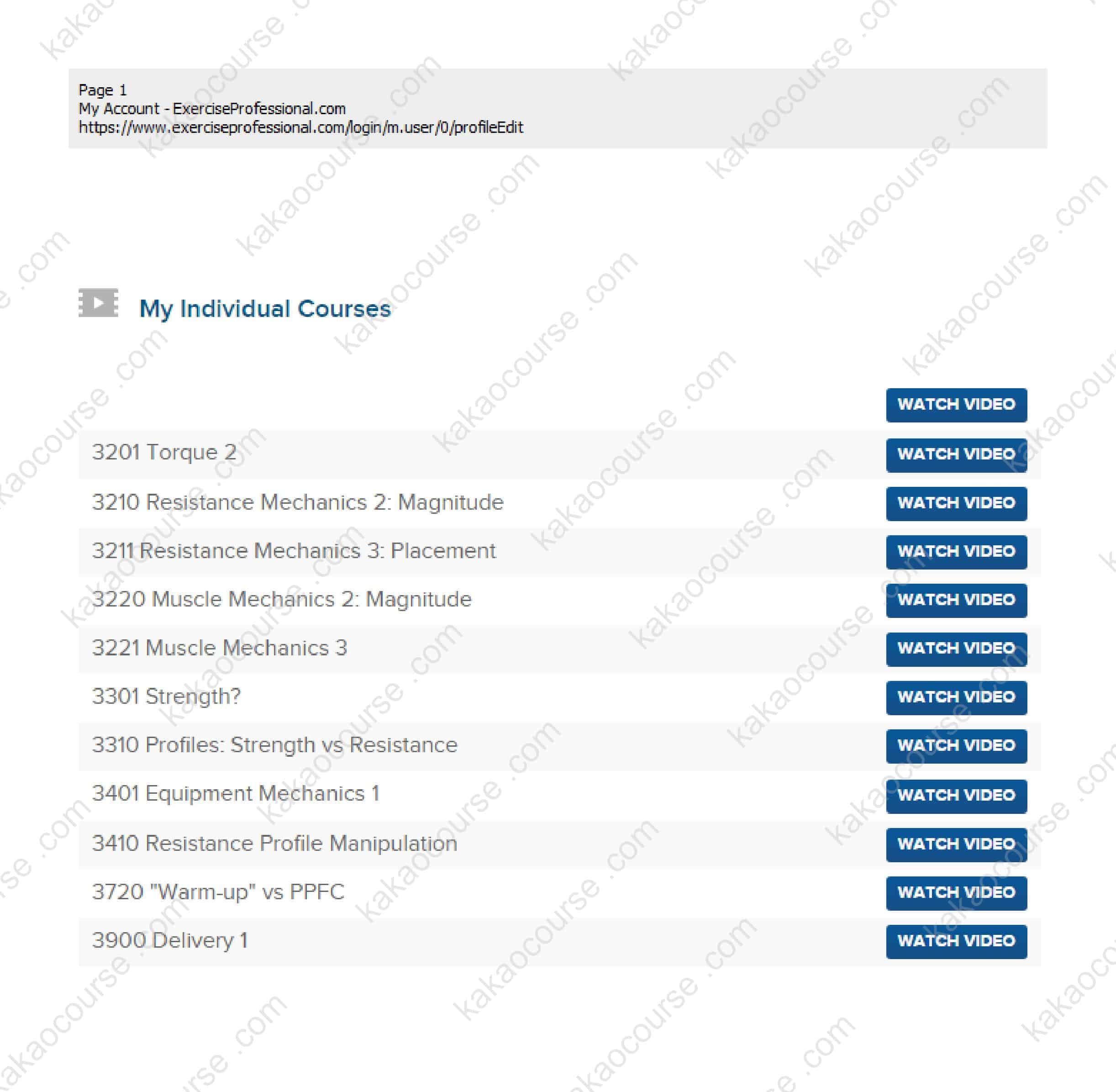
3000 (currently 30 hours) By Tom Purvis – Exercise Professional, Watch Our Free Video Sample to Find Out More:
3000 (currently 30 hours) By Tom Purvis – Exercise Professional, Free PDF Preview Available Below:
If you coach movement for a living, you already know that “good form” is not a cue—it’s a set of mechanics. The difference between average results and consistently high-quality outcomes often comes down to how well you understand torque, resistance, leverage, and equipment behavior in real training environments.
This is where 3000 (currently 30 hours) by Tom Purvis (Exercise Professional) positions itself: a deep, mechanics-first learning experience built for practitioners who want to make sharper training decisions with less guessing. The course includes ~30 hours of instruction, delivered as a 35.7 GB program, priced at $93.1—an accessible investment for coaches who value clarity, precision, and repeatable reasoning.
Overview This Course
3000 is an advanced learning program focused on the physics and biomechanics that govern resistance training. Rather than relying on trends, it builds your ability to explain what happens at joints and tissues when you change load, direction, body position, range of motion, tempo, and equipment.
Across the curriculum, you’ll move from “what exercise to pick” toward “why an exercise behaves the way it does,” including:
-
How rotational forces shape joint demands
-
How external resistance interacts with body geometry
-
How muscles express force under different leverage conditions
-
How equipment design changes the resistance you actually experience
If your goal is to coach with a more scientific, consistent logic—without making your sessions feel overly technical—this course gives you the mental model to do it.
Why Should You Choose This Course?
Many training courses teach “best practices.” Fewer teach first principles that remain valid across styles, equipment, and populations. The key value of 3000 is that it helps you build a durable framework for decision-making—useful whether you work in a commercial gym, performance setting, clinical-adjacent environment, or online coaching.
Reasons this course is worth your attention:
-
Mechanics-driven clarity: Learn to evaluate exercises by forces and constraints, not by popularity.
-
Better programming confidence: When you understand what drives joint torque and muscle demand, progression becomes more rational.
-
Transferable across equipment: Free weights, cables, machines, bands—your logic adapts because it’s built on underlying mechanics.
-
Higher coaching credibility: You can justify choices clearly to clients, athletes, colleagues, and stakeholders—especially in international, multidisciplinary teams.
-
Time-efficient learning depth: The content is long-form (about 30 hours), but organized around core principles that simplify real-world decisions.
This is especially helpful for international professionals working across diverse client profiles, where “one-size-fits-all cues” routinely fail.
What You’ll Learn
By completing 3000, you should be able to analyze resistance training like an engineer and coach like a professional—turning complex mechanics into actionable programming and coaching choices.
You’ll learn how to:
-
Model torque in human movement
-
Understand how rotational demand changes through a range of motion
-
Recognize when a “hard rep” is created by leverage—not effort alone
-
Predict which joint positions amplify or reduce mechanical stress
-
-
Interpret resistance beyond “how heavy”
-
Separate load magnitude from effective challenge
-
Understand how the line of pull and its placement change difficulty
-
Identify why two exercises with the same external load can feel completely different
-
-
Connect muscle behavior to mechanics
-
Relate muscle force potential to joint angle and leverage
-
Distinguish “muscle challenge” from “joint challenge” in practical terms
-
Clarify why certain ranges of motion become limiting (and what to do about it)
-
-
Define strength with more precision
-
Move beyond vague definitions and align strength with measurable mechanics
-
Understand why strength expression is specific to positions, vectors, and constraints
-
Identify the difference between training force production and training task tolerance
-
-
Compare strength capability vs resistance demand
-
Understand how strength capacity and external resistance change across a rep
-
Recognize mismatch patterns that create sticking points or compensation
-
Use profiles to select variations that better match your goal (hypertrophy, skill, performance, resilience)
-
-
Evaluate and manipulate equipment behavior
-
Understand how machines and cable systems shape resistance curves
-
Learn how small setup changes can dramatically shift the exercise stimulus
-
Apply practical methods to reshape the challenge without “changing the whole program”
-
-
Place preparation on a continuum
-
Distinguish between generic warm-up habits and purposeful preparation
-
Build more intentional preparation sequences aligned with the task demands
-
Reduce wasted time by linking prep to mechanics and motor output goals
-
-
Improve coaching delivery
-
Translate mechanics into short, useful coaching cues
-
Explain technique changes without overwhelming clients
-
Increase adherence by communicating “why this matters” clearly
-
The result is not just more knowledge—it’s a more reliable way to think.
Core Benefits
3000 is designed to produce practical benefits you can apply immediately in assessment, exercise selection, and programming—especially when working with varied bodies, different training histories, and multiple equipment environments.
Programming benefits
-
Choose exercises based on mechanical effect, not tradition
-
Build progressions that respect leverage, tolerance, and intent
-
Reduce “random variation” and increase purposeful variation
Coaching benefits
-
Create cues grounded in what actually drives the movement outcome
-
Identify compensation patterns earlier (and correct them more efficiently)
-
Communicate technique changes with greater confidence and consistency
Client and athlete outcomes
-
More targeted stimulus per session (less noise, more signal)
-
Better alignment between goal (strength, size, performance) and method
-
Reduced friction from exercises that don’t fit the individual’s structure or context
Professional development
-
Stronger interdisciplinary collaboration (coaches, clinicians, sport staff)
-
Higher quality decision-making under constraints (limited time, limited tools)
-
A conceptual framework you can keep using as you learn more
If you want your work to be both evidence-aligned and field-effective, a mechanics-first approach is a strong foundation.
Who Should Take This Course?
This program is best suited for learners who want more than a library of exercises—people who want a principled way to reason about training.
It’s a strong fit for:
-
Personal trainers and strength coaches who want deeper analysis skills
-
S&C professionals programming for athletes across different sports demands
-
Physio-minded coaches who work with joint constraints, pain history, or post-rehab transitions (without making clinical claims)
-
Exercise science students who want practical application of biomechanics
-
Online coaches needing a consistent system for remote form assessment and exercise selection
-
Gym owners / lead coaches building internal education standards for a team
You’ll benefit most if you:
-
Regularly coach resistance training (not just theory)
-
Want to improve decision-making consistency across clients
-
Prefer structured reasoning over trends and “influencer logic”
Conclusion
If you want to coach and program with more precision, you need tools that explain why an exercise works—not just how to perform it. 3000 (currently 30 hours) by Tom Purvis is built around exactly that: torque-based movement logic, resistance behavior, muscle-mechanics relationships, equipment analysis, training preparation on a continuum, and clearer coaching delivery.
In practical terms, this is a ~30-hour course with a 35.7 GB content package, priced at $93.1—a cost-effective way to develop mechanics literacy that can elevate your exercise selection, cueing, and programming across many populations and gym setups.
Choose the next training decision you want to improve, and use this course to build the mechanical reasoning that makes that improvement repeatable.







Reviews
There are no reviews yet.