
Car Design 101 – All in One Sketch Course by Berk Kaplan – Immediately Download
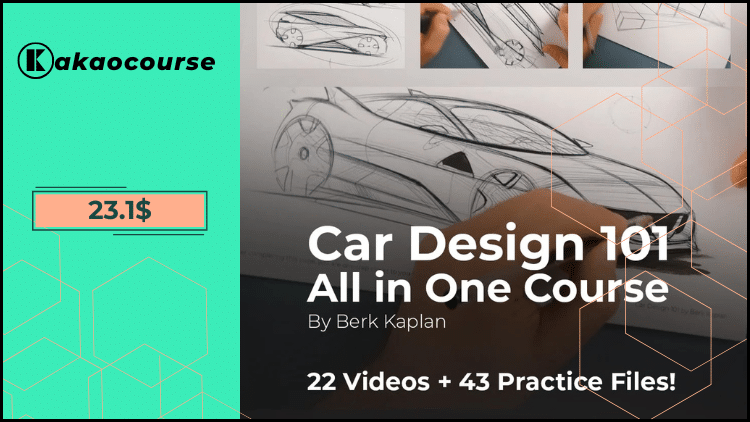
If you’ve ever tried to sketch a car and felt that something “looks off” without knowing why, you are not alone. Automotive sketching is a specialized discipline: it demands precise proportion control, a clean perspective logic, and confident lines that can communicate volume and attitude in seconds. Car Design 101 – All in One Sketch Course by Berk Kaplan is structured to help you build that foundation efficiently—without having to stitch together scattered tutorials or learn key principles in isolation.
Before we go further, here are the essential course details for international learners comparing options:
-
Digital size: 3.52 GB
-
Price: $23.1
-
Video time: a little over 2 hours of instruction
-
Lesson count: 22 focused videos (theory + guided sketching)
-
Practice assets: 43 printable practice files designed for repetition and skill calibration
This course is especially relevant if you’re receiving feedback like “watch your proportions” or you find that vehicle perspective feels different from typical product sketching. The material aims to create a clear mental model first—then convert that model into repeatable sketch habits.
Free Download Car Design 101 – All in One Sketch Course by Berk Kaplan – Here’s What You’ll Get Inside:
Car Design 101 – All in One Sketch Course by Berk Kaplan, Check Out the Full Course Contents:
Car Design 101 – All in One Sketch Course by Berk Kaplan, Watch Our Free Video Sample to Find Out More:
Car Design 101 – All in One Sketch Course by Berk Kaplan, Free Image Preview Available Below:
Car Design 101 – All in One Sketch Course by Berk Kaplan, Check Another Image Sample:
Overview This Course
Car Design 101 is an all-in-one sketching program built around the core mechanics of professional-looking vehicle sketches. Instead of treating proportion, perspective, line quality, and shading as separate topics, the course organizes them as a unified workflow—closer to how designers actually work in practice.
The learning pathway moves from structured guidance to independent execution:
-
Foundations: understand why certain car silhouettes read as “correct” and others don’t
-
Guided sketching: apply principles using practice templates to reduce guesswork
-
Independent sketching: transition toward drawing on a blank page with stronger control
A key advantage here is the integration of print-ready practice files. These assets allow you to repeat the same visual problem under controlled conditions—useful for developing accuracy in proportion and perspective, where improvement often depends on deliberate repetition rather than passive watching.
You’ll also see the sketching approach applied across multiple vehicle categories (e.g., everyday segments and more performance-oriented forms), which matters because each segment carries its own stance, mass distribution, and design language.
Why Should You Choose This Course?
Selecting a sketch course is less about “how much content” and more about whether the content is organized to produce reliable skill transfer. Car Design 101 positions itself around a practical question: how do you move from uncertain sketches to drawings that look intentional?
Reasons this course stands out for skill-building:
-
One coherent system, not disconnected tips
Instead of collecting shortcuts, you build a structured understanding of what makes a car sketch read professionally: stance, balance, volumes, and visual hierarchy. -
Vehicle perspective treated as its own discipline
Many learners struggle because car sketching does not behave like generic product sketching. Cars have long horizontal features, tight curvature transitions, and a strong “grounded” relationship to the road plane. This course targets that specific reality. -
Practice-led design education
The 43 printable practice files support repetition—helping you refine proportion judgment, correct perspective drift, and improve line control through consistent iteration. -
Progression from support to independence
The course doesn’t assume you can jump straight to a blank sheet. It guides you from practice templates to freehand decisions—an important bridge for confidence.
If you want a single course that covers the essential building blocks without fragmenting your learning, this “all-in-one” design is the main value proposition.
What You’ll Learn
The course focuses on the fundamentals that repeatedly appear in professional automotive sketches—skills that influence how “real” and “designed” your drawings look. While each learner progresses differently, the curriculum is oriented around practical competencies you can apply immediately.
By the end of the course, you should be able to:
-
Diagnose proportion issues (and know what to adjust, not just that something is wrong)
-
Construct vehicle forms with clearer perspective logic, especially in common 3/4 views
-
Sketch multiple car segments with appropriate stance and silhouette language
-
Improve line quality and line weight control to communicate depth and hierarchy
-
Add basic shading strategically to clarify surfaces and volumes without over-rendering
-
Develop better visual balance so sketches look composed rather than accidental
-
Practice efficiently using repeatable templates that train your eye and hand together
Core topics integrated throughout the lessons include:
-
Proportions and stance (wheelbase, overhang relationships, cabin-to-body balance)
-
Perspective principles tailored for vehicles (horizon logic, convergence control, symmetry cues)
-
Creativity and variation (generating alternatives without losing structure)
-
Line quality + line weight (confidence, emphasis, and readable silhouettes)
-
Basic shading for form clarity (simple value decisions that support volume)
-
Balance and presentation (keeping the sketch visually stable and intentional)
-
Structured practice (how to repeat exercises so improvement accumulates)
This set of outcomes addresses common bottlenecks: unclear proportions, unstable perspective, hesitant lines, and “flat” volumes.
Core Benefits
For international customers evaluating online training, benefits need to be clear, transferable, and grounded in how skills are built. Car Design 101 offers practical advantages that go beyond simply adding hours of video to your library.
1) Faster feedback loops through practice files
Printable templates enable consistent repetition. That consistency helps you spot patterns in your errors—especially in:
-
proportion drift (cars becoming too tall, too short, or visually “unbalanced”)
-
perspective inconsistency (features not converging logically)
-
uneven line confidence (hesitant strokes that reduce design clarity)
2) Improved sketch readability
Professional sketches are not only accurate—they are readable. The course emphasizes line hierarchy and simple shading so viewers can quickly understand:
-
what surface turns where
-
which edges are primary vs. secondary
-
how the car sits on the ground plane
3) Segment versatility
Learning across different vehicle types helps you avoid “one silhouette only” limitations. You practice adapting fundamentals to different mass distributions and design cues—useful whether you’re exploring SUVs, sedans, hatchbacks, sporty coupes, or pickups.
4) A structured route from guided to freehand
Many learners can follow a tutorial but struggle alone. This course is designed to reduce that gap by gradually shifting responsibility from the template to your own construction decisions.
5) Compact and focused
With a little over two hours of instruction, the content aims to stay concentrated on essentials rather than expanding into unrelated topics. For many learners, that focus supports completion and consistent practice.
Who Should Take This Course?
This course is most suitable for learners who want a disciplined entry point into car sketching—or a reset that clarifies fundamentals they feel uncertain about.
You should consider this course if you are:
-
a beginner who wants a structured foundation in automotive sketching
-
an intermediate learner who sketches often but struggles with proportion and perspective consistency
-
a product/industrial sketcher noticing that cars “don’t behave the same way” on paper
-
a design student building an automotive portfolio and needing cleaner sketches
-
a hobbyist who wants stronger confidence across multiple vehicle segments
Helpful mindset (no special background required):
-
willingness to repeat exercises (practice is part of the learning design, not an optional add-on)
-
comfort with incremental improvement rather than instant results
-
interest in building fundamentals: proportion logic, perspective structure, and line control
If you prefer courses that combine conceptual clarity with applied drawing demonstrations—and you want practice materials to support repetition—this program aligns well with that learning preference.
Conclusion
Car Design 101 – All in One Sketch Course by Berk Kaplan is a compact, practice-oriented program that consolidates the fundamentals of automotive sketching into a single, coherent learning path. By integrating proportion, vehicle-specific perspective, line quality, line weight, and basic shading into one workflow, the course targets the exact areas that typically separate casual sketches from drawings that look more professional and intentional.
For clarity on logistics before you decide:
-
Digital size: 3.52 GB
-
Price: $23.1
-
Content package: 22 videos plus 43 printable practice files (a little over 2 hours of instruction)
If you want an efficient way to strengthen your car sketching fundamentals with guided practice assets and a structured progression toward sketching on a blank sheet, this course is a pragmatic option to consider.
Build your automotive sketching foundation today with Car Design 101 and start practicing with a system that makes proportions, perspective, and linework easier to control.








Reviews
There are no reviews yet.