
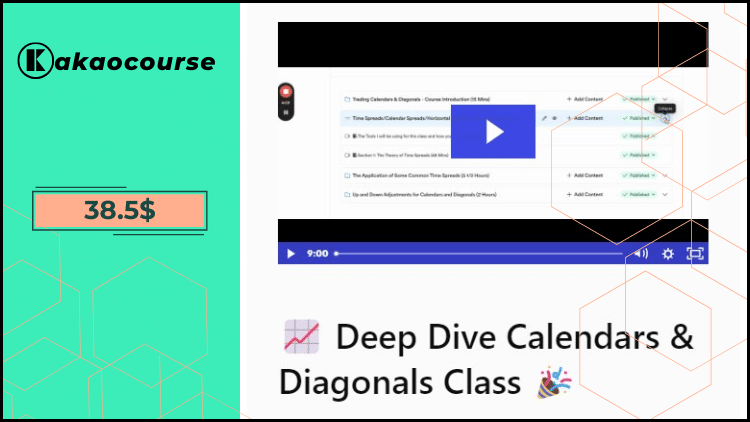
Deep Dive Calendars & Diagonals Class by SJG Trades – Immediately Download
Options traders who want consistency eventually discover a hard truth: direction is only one dimension of the trade. Time, volatility, and structure often matter more—especially when markets rotate, implied volatility shifts, or catalysts like earnings compress and expand premiums. That is exactly why calendars and diagonals remain core tools for traders who want defined risk profiles and more control over trade design.
Deep Dive Calendars & Diagonals Class by SJG Trades is a focused, self-paced training designed to help you understand and apply time spreads with clarity—moving beyond surface-level definitions into practical selection, construction, and management. The class emphasizes when to use each variation, what conditions support it, and how to think about risk and opportunity in a structured way.
Course Size & Price (Upfront):
-
Digital size: 3.19 GB
-
Price: $38.5
If you’ve been using calendars inconsistently—or you’ve avoided them because they feel “too complex”—this deep dive is structured to make the logic operational and tradable.
Free Download Deep Dive Calendars & Diagonals Class by SJG Trades – Here’s What You’ll Get Inside:
Overview This Course
Deep Dive Calendars & Diagonals Class by SJG Trades is a targeted course centered on the application of time spreads in options trading, with specific attention to calendar structures and how they extend into diagonal strategies. The training is organized into concise sections that build from foundational mechanics to advanced setups.
The covered sections highlight a logical progression:
-
Application of Time Spreads: establishing what time spreads do, how they behave, and why they can be useful in non-linear market conditions
-
Long vs. Short Calendars: comparing trade intent, volatility exposure, and risk profiles
-
Put vs. Call Calendars: selecting structure based on market context and directional bias
-
Calendars Around Earnings: designing calendar approaches around event-driven volatility dynamics
-
Limited Backtesting Information: using selective historical reasoning to refine expectations and avoid naive assumptions
-
Double and Triple Calendars: expanding into multi-calendar structures and understanding the additional complexity in setup and management
Instead of presenting calendars as a “one-size-fits-all” strategy, this class positions them as a design framework: a method for choosing time and strike relationships that express a view on direction, volatility, and timing.
Because calendars and diagonals can look deceptively simple but behave very differently across regimes, a structured deep dive is valuable. This course aims to help you avoid common errors such as trading calendars without a volatility thesis, placing structures poorly around catalysts, or mismanaging the position when conditions shift.
Why Should You Choose This Course?
Traders often learn calendars from fragmented sources: a thread here, a video there, a few screenshots of profit curves—without a rigorous framework for selection and management. That gap leads to inconsistent outcomes and an inability to diagnose what went wrong.
This course is worth choosing if you want:
-
A practical framework for time spreads, not just definitions
You learn how calendars function as an expression of time and volatility relationships, not merely as “selling short-dated and buying long-dated.” -
Clear differentiation between variants (long/short, put/call)
Many mistakes come from applying the wrong structure to the wrong market environment. The course addresses these distinctions directly. -
Event-driven application (earnings) explained in a structured way
Earnings trading can punish vague thinking. This class focuses on designing calendars around earnings with a more intentional approach. -
Exposure to advanced structures (double/triple calendars)
Multi-calendar setups can expand opportunity, but they also increase complexity. Learning them in a guided deep dive reduces avoidable trial-and-error. -
Selective backtesting context without overpromising
Options strategies are sensitive to regime changes. The course’s inclusion of limited backtesting discussion helps you interpret history without treating it as certainty.
This is especially relevant if your goal is to move from “trying calendars occasionally” to using time spreads as a repeatable toolset with clearer decision rules.
What You’ll Learn
By completing this class, you should be able to design and evaluate calendar/diagonal-style trades more systematically. Key learning outcomes include:
-
Core mechanics of time spreads
-
Why time spreads behave differently from outright directional options
-
What dimensions matter most (time decay, volatility, strike selection, and structure)
-
-
Long vs. short calendar decision logic
-
How these structures differ in intent and risk profile
-
What market conditions tend to align with each approach
-
How to think about trade-offs rather than “right vs wrong”
-
-
Put vs. call calendar selection
-
How to choose structure based on market context
-
How directional bias interacts with the calendar design
-
When the choice is more about structure than opinion
-
-
Calendars around earnings
-
How to approach earnings season with a volatility-aware framework
-
How to avoid common earnings-specific pitfalls
-
How timing and positioning influence outcomes around announcements
-
-
Using limited backtesting insight responsibly
-
How to extract useful signal from selective scenarios
-
How to avoid overfitting expectations to historical samples
-
How to convert observations into practical rules-of-thumb
-
-
Advanced setups: double and triple calendars
-
How multi-calendar structures change payoff behavior
-
What additional variables you must manage
-
How to think about setup, adjustment, and risk control at a higher complexity level
-
Collectively, these outcomes are aimed at making calendars and diagonals less intimidating and more usable, particularly for traders who want structured, repeatable methods.
Core Benefits
Deep Dive Calendars & Diagonals Class by SJG Trades is designed to deliver benefits that translate into better trade construction and decision-making.
1) Better trade selection through structure awareness
You improve your ability to match the right calendar structure to the right environment, reducing “random deployment.”
-
More clarity on when calendars make sense
-
Better alignment between market conditions and strategy
-
Fewer trades driven by guesswork
2) More disciplined earnings-season positioning
Earnings are a common source of inconsistent results. A structured approach helps you treat earnings as a defined volatility event rather than a gamble.
-
More intentional placement around catalysts
-
Better understanding of event-driven volatility behavior
-
Reduced reliance on intuition alone
3) Reduced complexity through clear comparisons
Calendars can feel complex because small changes (strike, timing, option type) alter the profile. The course organizes those variables into understandable decision points.
-
Cleaner differentiation between long vs short, put vs call
-
Practical reasoning for selecting variants
-
Improved ability to troubleshoot a trade after the fact
4) Capability to explore advanced setups responsibly
Double and triple calendars can expand opportunity but also magnify mistakes. Learning them in a structured setting helps you approach advanced designs with control.
-
Better awareness of added complexity and risk
-
Improved design thinking for multi-structure trades
-
A more systematic pathway to scaling skill
5) A reusable mental model for time spreads
Instead of memorizing one “calendar recipe,” you develop a model you can apply across symbols, regimes, and volatility environments.
Who Should Take This Course?
This class is best suited for options traders who want to strengthen their skill in time spread construction and management.
It is a strong fit for:
-
Intermediate options traders who understand basic options but want deeper structure mastery
-
Traders exploring calendars and diagonals who want a clearer framework for selection and setup
-
Earnings-season traders who want a more disciplined approach to event-driven positioning
-
Systematic-minded discretionary traders who prefer structured logic over improvisation
-
Traders looking to expand beyond directional plays into time/volatility-aware structures
This course may be less suitable if you are looking for a “single signal” strategy or if you do not yet have comfort with basic options concepts (calls, puts, expirations, and strikes). The value here is in structure and application, not introductory options fundamentals.
Educational note: this content is for education and skill development. It is not financial advice and does not guarantee outcomes.
Conclusion
Deep Dive Calendars & Diagonals Class by SJG Trades provides a focused pathway to understanding and applying time spreads with greater confidence—covering calendar structure selection, put/call nuance, earnings applications, limited backtesting context, and advanced multi-calendar setups. For traders who want to move from occasional experimentation to a repeatable framework, this class is positioned as a practical skill builder.
Course Details (Confirmed):
-
Digital size: 3.19 GB
-
Price: $38.5
If you want to elevate how you structure options trades—especially around time, volatility, and event risk—this deep dive offers a clear, organized route.
Access Deep Dive Calendars & Diagonals Class by SJG Trades and start building calendar and diagonal trades with a more deliberate, professional framework.








Reviews
There are no reviews yet.