
Liquidity Mastery – Learn to Trade Where Retail Dies – Immediately Download
Most retail traders don’t fail because they “don’t know enough indicators.” They fail because they enter where liquidity is easiest to take—at obvious breakouts, predictable stop placements, and crowded technical levels. In institutional terms, that’s not opportunity; it’s inventory.
Liquidity Mastery – Learn to Trade Where Retail Dies is a tactical, visually driven guide built to help you read the liquidity layer of the forex market: where orders cluster, where traps form, and how price often moves to collect stops before a directional expansion. It focuses on recognizable, repeatable structures—like equal highs/lows, liquidity sweeps, and engineered reversals—so your decisions rely less on hope and more on market mechanics.
This guide is delivered as a compact 45.0 MB package and priced at $15.4, making it a lightweight, globally accessible upgrade for traders who want sharper entries and fewer “why did it reverse right after I bought?” moments.
Free Download Liquidity Mastery – Learn to Trade Where Retail Dies – Here’s What You’ll Get Inside:
Liquidity Mastery – Learn to Trade Where Retail Dies, Sneak Peek Inside The Course:
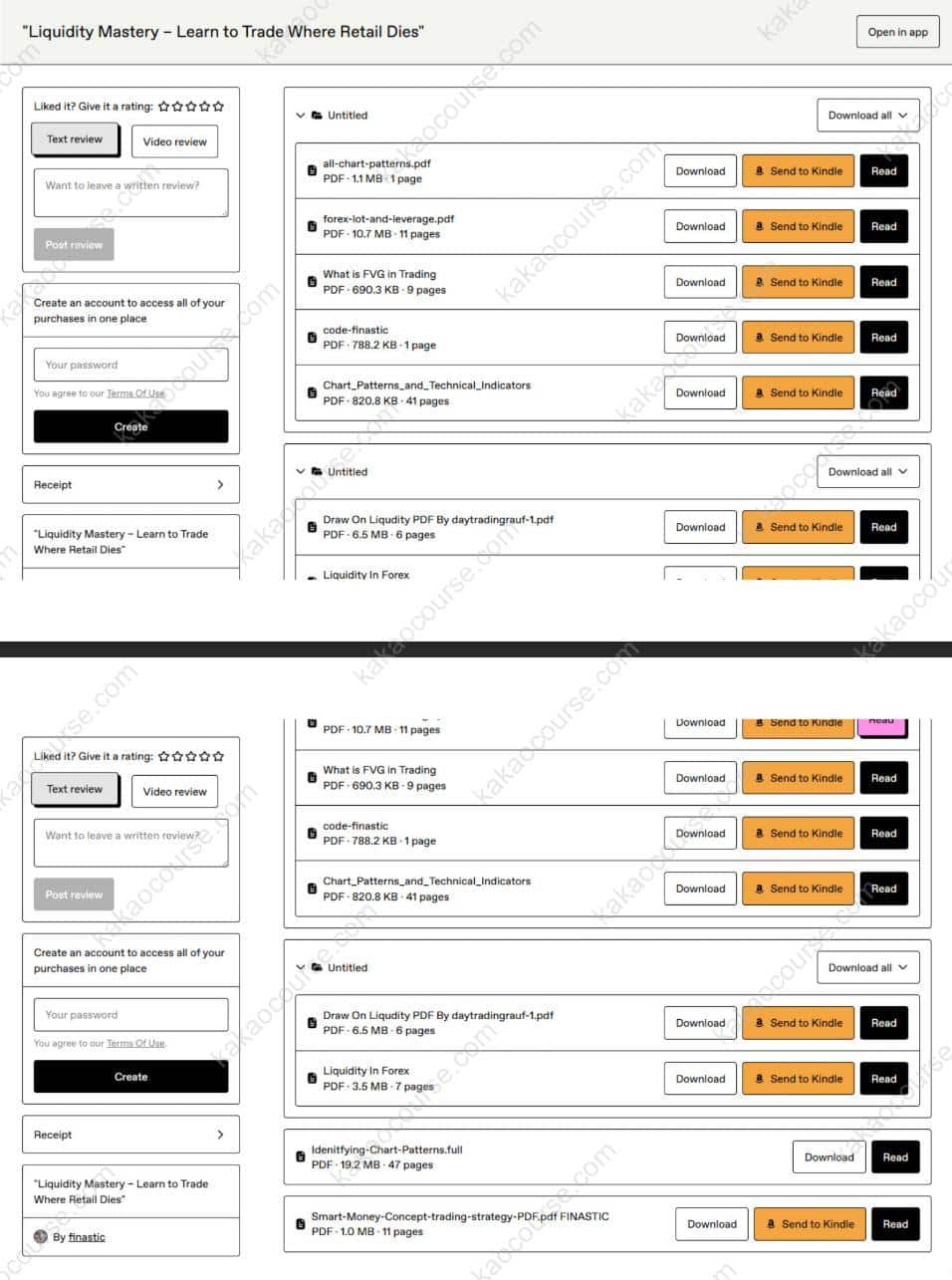
Liquidity Mastery – Learn to Trade Where Retail Dies, Free PDF Preview Available Below:
Overview This Course
Liquidity is not a buzzword. In FX, liquidity is the fuel that allows large participants to execute size efficiently. That execution process leaves patterns—sometimes subtle, sometimes obvious—especially around session opens (London and New York) and around levels where retail traders concentrate orders.
This guide reframes trading around a central idea: price often moves toward liquidity before it moves away from it. Instead of treating stop runs as “random manipulation,” you learn to interpret them as a rational search for fills and imbalance resolution.
Inside Liquidity Mastery, the method is taught as a practical workflow:
-
Identify where retail participation clusters (equal highs/lows, obvious swing points, clean trendline breaks)
-
Anticipate sweep behavior (the run above/below a level that triggers stops and creates liquidity)
-
Use institutional-style reference zones—such as Fair Value Gaps (FVGs) and Order Blocks (OBs)—to time entries after the sweep, not before it
-
Align setups to the NY and London session rhythm to reduce noise and improve timing
-
Validate with visual models rather than overloaded charts
The result is not a “one setup fixes all” promise. It’s a structured way to stop trading the same crowded areas as everyone else—and to start reading the market’s intent through liquidity.
Why Should You Choose This Course?
A common trap in trading education is teaching more tools without improving decision quality. Traders end up with more signals, more charts, and more confusion—while still entering at the wrong locations.
This guide is valuable because it prioritizes location and behavior over indicator stacking:
-
It explains why traps occur, not just that they occur
You learn the logic behind stop-hunts and liquidity runs, so you can anticipate them instead of reacting late. -
It’s designed for fast pattern recognition
The guide emphasizes visual clarity and structured models—useful for traders who learn best by seeing setups mapped cleanly. -
It integrates modern “smart money” concepts into a practical entry process
FVGs and Order Blocks are framed as timing and location tools—particularly after a sweep event. -
It is built around session reality (London & New York)
Liquidity behavior is not uniform throughout the day. Understanding session dynamics can help you avoid forcing trades in low-quality conditions. -
It targets the most expensive retail mistake: trading where stops are obvious
The guide trains you to spot where retail tends to be positioned—and how to avoid becoming exit liquidity.
If you’ve experienced repeated reversals immediately after entry, or you often feel “right about direction but wrong about timing,” liquidity-based thinking typically addresses that gap.
What You’ll Learn
Liquidity Mastery is structured to build conceptual understanding and translate it into executable models. After working through the guide, you should be able to recognize high-probability liquidity behaviors and design entries that are more aligned with institutional execution patterns.

You will learn:
-
How liquidity actually functions in forex
-
Why large participants need pools of orders to execute efficiently
-
How stop clusters and breakout entries create those pools
-
Why price frequently “visits” levels before making a clean move
-
-
How to spot equal highs/lows and likely liquidity pools
-
Identifying common retail stop placement zones
-
Recognizing repeated highs/lows as liquidity magnets
-
Distinguishing meaningful liquidity pools from random symmetry
-
-
Liquidity sweep setups (visually explained)
-
The anatomy of a sweep: approach → run → rejection/shift
-
How sweeps differ from genuine breakouts
-
Where traders typically get trapped—and what to look for instead
-
-
How to time entries using Fair Value Gaps and Order Blocks
-
Using FVGs as “imbalanced” zones that often get revisited
-
Using Order Blocks as practical reference areas for post-sweep entries
-
Building entry logic that reduces chasing and improves positioning
-
-
Trap-zone psychology and how to avoid becoming the target
-
Why traders buy “confirmation” that is actually late-stage liquidity
-
How fear-of-missing-out reinforces poor location
-
What disciplined waiting looks like in a liquidity-based plan
-
-
Real trade models aligned with London and NY sessions
-
Understanding why these sessions often provide cleaner liquidity events
-
How to structure attention windows (instead of trading all day)
-
Building repeatable playbooks for session-based execution
-
Importantly, the guide focuses on readable, reusable models—not vague market storytelling—so you can review charts, backtest patterns, and refine execution systematically.
Core Benefits
A good trading method should reduce randomness in three areas: where you enter, when you enter, and why you believe the setup is valid. Liquidity Mastery is designed to strengthen those pillars.
Core benefits include:
-
Better location selection
-
You learn to focus on areas where liquidity events tend to form
-
You reduce entries at crowded “obvious” levels that are prone to sweeps
-
-
Cleaner timing and fewer impulse trades
-
The guide trains a “wait for the sweep, then act” approach
-
This often improves entry efficiency relative to breakout chasing
-
-
More objective setup recognition
-
Visual models help you standardize what qualifies as a sweep setup
-
You can build a checklist to evaluate trades consistently
-
-
Improved understanding of false breakouts
-
Many retail losses come from treating every break as continuation
-
Liquidity-based logic helps you differentiate continuation vs. engineered traps
-
-
Session-aware structure
-
Focusing on NY/London models can reduce low-liquidity noise trades
-
You shift from “always trading” to “trading when conditions are present”
-
-
A practical foundation for risk discipline
-
Liquidity-based entries often allow more structured invalidation logic
-
Clear invalidation points can support more consistent risk-to-reward planning
-
This guide does not remove market risk—nothing does—but it aims to reduce the avoidable risk created by poor location, late entries, and misunderstanding liquidity behavior.
Who Should Take This Course?
Liquidity Mastery is best for traders who already know basic chart reading and want to upgrade entry logic and market interpretation—especially in forex.
This guide is suitable for:
-
Forex traders stuck in repeated “stop-outs before the move”
-
If price routinely tags your stop then runs in your direction, liquidity concepts are directly relevant.
-
-
Retail traders who rely heavily on breakouts and indicators
-
The guide helps you see why many breakout entries fail and how to reframe timing.
-
-
Intermediate traders exploring smart-money concepts
-
If you’ve heard of FVGs, order blocks, or liquidity sweeps but lack a practical structure, the guide provides a clearer pathway.
-
-
Session-based traders (London/NY)
-
If you prefer trading specific windows, the session models can support more consistent routines.
-
-
Traders who want a visually clear, tactical learning format
-
The guide is designed to reduce ambiguity and speed up pattern recognition.
-
A sensible baseline: comfort with candlesticks and basic support/resistance. From there, the guide’s value comes from reorganizing your attention around where liquidity sits and how it gets taken.
Conclusion
Liquidity is one of the most actionable lenses in forex because it explains why price travels to certain levels and why retail entries are often punished before the main move unfolds. Liquidity Mastery – Learn to Trade Where Retail Dies delivers a compact, practical framework to spot liquidity pools, recognize sweep behavior, and time entries with institutional reference zones like Fair Value Gaps and Order Blocks—especially during New York and London sessions.
The guide package size is 45.0 MB and the price is $15.4, positioned as a lightweight, high-impact learning resource for traders who want to stop trading crowded retail zones and start thinking in liquidity terms.
Upgrade your trading framework today with Liquidity Mastery and start planning entries around liquidity sweeps instead of chasing late confirmations.







Reviews
There are no reviews yet.