
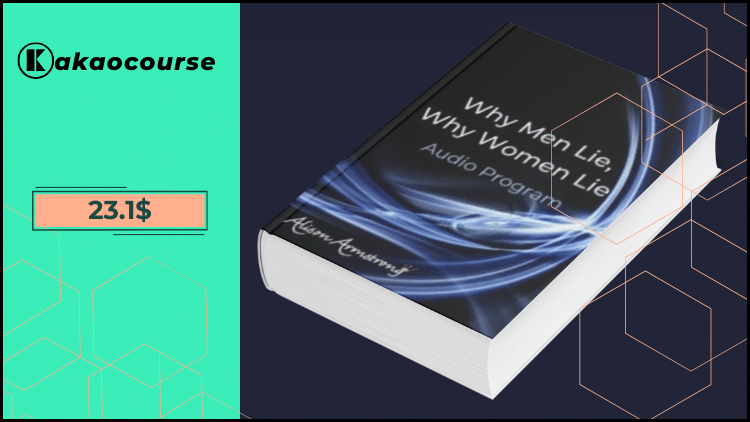
Why Men Lie, Why Women Lie – Audio Program By Alison Armstrong – Immediately Download
Trust is fragile. Once a lie enters a relationship—personal or professional—everything starts to feel uncertain: What’s true? What’s missing? What can I rely on? Yet honesty is rarely just a “moral choice.” In many cases, it’s shaped by fear, social pressure, conflict-avoidance, and a learned instinct to protect connection or status.
Why Men Lie, Why Women Lie is an on-demand audio program by Alison Armstrong that explores why people lie, how those patterns differ across men and women (without making it a blame game), and what you can do to invite greater truthfulness in real conversations.
-
File size: 446.9 MB
-
Price: $23.1
-
Format: Audio program (listen at your own pace)
-
Best for: Communication growth, conflict repair, and rebuilding trust through better conversational dynamics
If you want a clearer, more usable way to respond to dishonesty—without escalating conflict—this program is built for that.
Free Download Why Men Lie, Why Women Lie – Audio Program By Alison Armstrong – Here’s What You’ll Get Inside:

Overview This Course
Why Men Lie, Why Women Lie is a guided audio learning experience focused on one core question: How do we move from suspicion and defensiveness to honesty and partnership? Instead of treating lying as a simple character flaw, the program frames it as a behavior that often emerges under perceived threat—threat to reputation, belonging, peace, autonomy, or identity.
The “men vs. women” lens is used to examine common patterns in socialization and communication, not to stereotype. The program emphasizes that:
-
Not all men lie for the same reasons
-
Not all women lie for the same reasons
-
Many people shift strategies depending on context (work, family, intimacy, authority, risk)
What makes this audio program especially useful is its practical orientation. You’re not only learning why lying happens—you’re learning how to change the conditions of a conversation so honesty becomes easier and safer.
Why Should You Choose This Course?
Most resources about lying focus on detection—spotting tells, catching contradictions, proving someone wrong. That approach can sometimes intensify distrust and create a cycle of interrogation. This program takes a different route: it focuses on relational dynamics and communication design, so your interactions become less threatening and more truth-friendly.
You should choose this audio program if you want to:
-
Stop turning every difficult conversation into a courtroom
-
Reduce defensiveness (in yourself and others) so truth has room to emerge
-
Handle dishonesty without escalating, shaming, or controlling
-
Understand how fear, scarcity thinking, and approval-seeking can drive distortion
-
Learn responses that restore collaboration rather than deepen distance
For international listeners, the value is also in its broad applicability: the insights are relevant across cultures because they focus on universal human motivations (safety, belonging, respect, autonomy), while acknowledging that how people express those needs can vary.
What You’ll Learn
By the end of the program, you’ll be equipped with a more precise map of what lying often signals—and how to respond in a way that improves the odds of honesty next time.
You’ll learn how to:
-
Identify common motivations behind lies (e.g., fear of conflict, fear of judgment, fear of losing status or connection)
-
Understand gender-patterned tendencies in dishonesty as described in the program—while keeping a non-stereotyping mindset
-
Recognize how certain communication styles can unintentionally push people toward concealment
-
Create conversational “conditions” that make truth less risky to share
-
Respond to lies in a way that reduces damage and reopens dialogue
-
Replace accusation-based language with precision questions that invite clarity
-
Shift from “Who’s wrong?” to “What’s happening here, and what do we need to repair?”
You’ll also gain practical strategies for:
-
Addressing “half-truths” and omissions without triggering shutdown
-
Navigating situations where someone changes their story
-
Moving forward after a lie without pretending it didn’t matter
Core Benefits
This audio program supports both personal development and relationship competence. The benefits aren’t limited to intimate relationships—you can apply them in teams, negotiations, leadership conversations, and high-stakes discussions.
Core benefits include:
-
A calmer, more strategic response to dishonesty
You learn to respond with clarity and boundaries, rather than reactive anger or silent resentment. -
Improved conversational safety
When people feel less threatened, they become more capable of truth-telling—even about uncomfortable topics. -
Stronger repair skills after conflict
The program emphasizes restoring collaboration, not scoring points. -
Better understanding of “why” beneath behavior
When you grasp motivation, you stop personalizing everything—and you make better decisions. -
More effective communication across differences
Gender differences are discussed as patterns, but the deeper skill is learning how to communicate across different coping strategies and emotional risk thresholds.
Practical outcomes you can expect to develop:
-
More productive conversations under stress
-
Less circular arguing (“You always…” / “I never…”)
-
Greater ability to rebuild trust through consistent interaction, not forced reassurance
Who Should Take This Course?
This program is a fit for learners who want real-world communication skill rather than theory alone. It is especially suitable for:
-
Couples or partners navigating trust issues, defensiveness, or recurring misunderstandings
-
Co-parents or family members who need clearer, less volatile communication
-
Managers and team leads dealing with avoidance, misreporting, or “political truth” in organizations
-
Coaches, therapists, educators, and facilitators seeking language and framing tools for relational repair
-
Anyone who feels stuck in suspicion and wants a path back to constructive dialogue
It’s also helpful if you recognize any of these patterns:
-
You often think, “I can’t tell what’s real anymore.”
-
You either confront too aggressively—or avoid confrontation entirely.
-
You feel responsible for “extracting” honesty rather than inviting it.
-
You want to respond to dishonesty with boundaries + connection, not punishment.
Not ideal if you’re only looking for lie-detection tricks. This program is more about relationship ecology: what conditions increase honesty, and what conditions predict concealment.
Conclusion
Dishonesty is painful—but it’s also frequently informative. It can signal fear, pressure, insecurity, or a belief that truth will lead to rejection or conflict. Why Men Lie, Why Women Lie helps you interpret those signals with more precision, and respond in ways that make honesty more likely over time.
Rather than training you to “win” against a liar, the program strengthens your capacity to:
-
hold clear boundaries,
-
reduce conversational threat,
-
restore partnership after rupture,
-
and build a communication style that supports truth without coercion.
Program details (for quick reference):
-
File size: 446.9 MB
-
Price: $23.1
If you’re ready to replace suspicion and conflict with communication that actually improves honesty, start listening to Why Men Lie, Why Women Lie and apply the first technique in your next real conversation.





Reviews
There are no reviews yet.